Image Recognition in Real Life - How to Build with AI in Minutes
Image recognition has quietly become one of the most impactful AI technologies in daily life - from unlocking your phone to helping farmers monitor crop health via drone footage.
Introduction
Image recognition has quietly become one of the most impactful AI technologies in daily life - from unlocking your phone to helping farmers monitor crop health via drone footage. But while its real-world impact is clear, many developers still assume it’s hard to implement. This blog walks through a fully functional image classification example using just a few lines of Python code - no training, no custom models, no barriers.
Inspired by Andrej Karpathy’s approach of “get your hands dirty with code,” this post emphasizes clarity over complexity. Let’s decode what image classification actually means and build something useful - fast.
What Is Image Recognition, Really?
At its core, image recognition (or image classification) is about teaching machines to recognize what’s in a picture. Think of it like this: you show a baby an image of a cat and say “cat.” After enough examples, they’ll learn to point out a cat on their own. AI does the same - just faster and at scale.
Applications include:
- Photo Tagging on platforms like Facebook or Google Photos
- Medical Imaging to flag abnormalities in X-rays
- Retail Scanning to identify items on shelves
- Disaster Assessment using satellite photos
- And of course, everyday fun - like identifying dog breeds, plants, or products through your smartphone camera.
Let’s Build It in Code
from transformers import pipeline

classifier = pipeline("image-classification")
results = classifier("cat_photo.jpg")
print(results[0]['label'], "with confidence", round(results[0]['score'], 2))
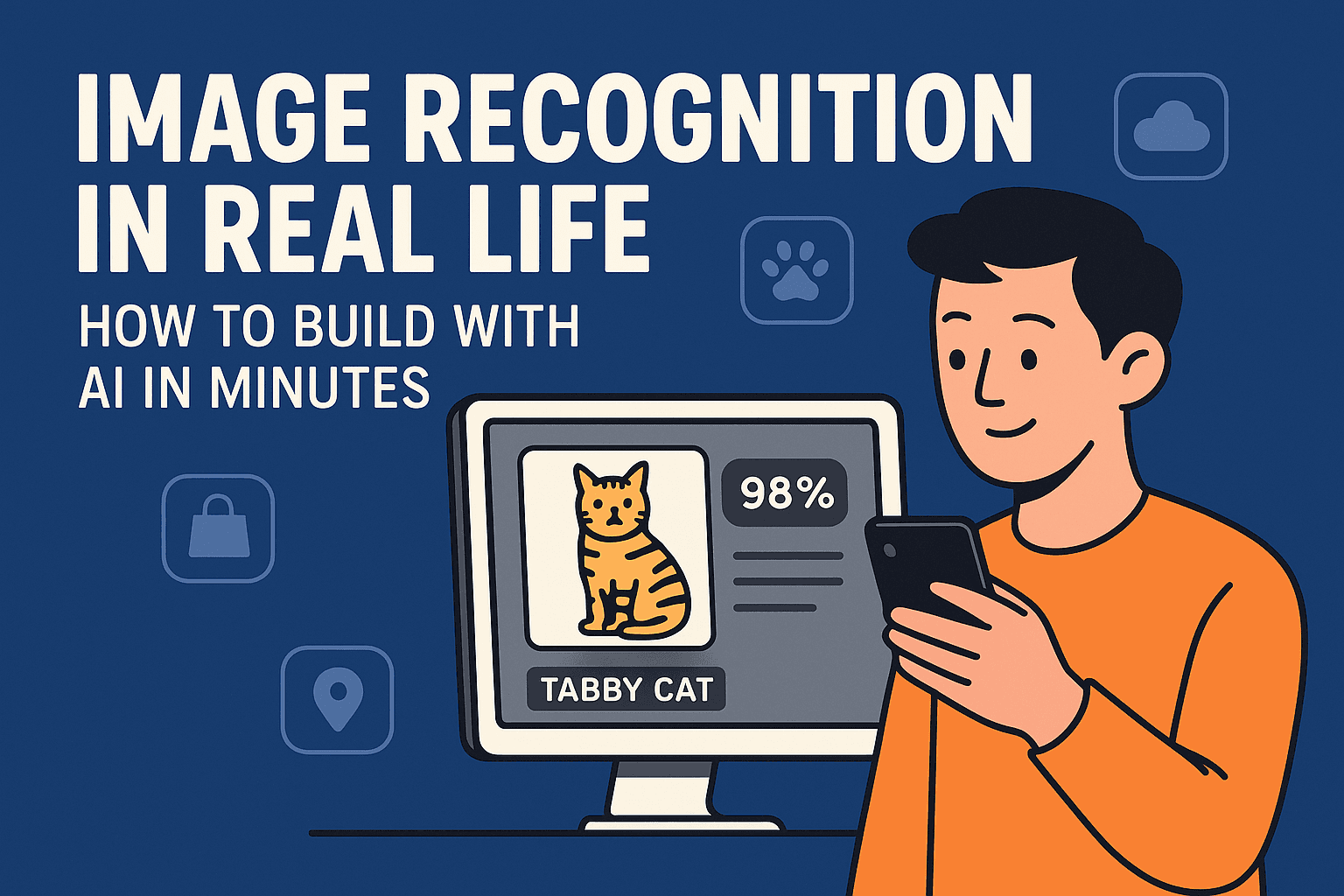
That’s it. One line loads a pre-trained model, another classifies an image. If you run this on a photo of a domestic cat, you might get:
TABBY CAT with confidence 0.98
What’s Happening Under the Hood?
Behind that simplicity, you’re accessing a model trained on ImageNet - a dataset with over 14 million images. The Hugging Face pipeline abstracts all the preprocessing, feature extraction, and model inference. It might use a ResNet or Vision Transformer model without you needing to care.
This “default first” mindset allows developers to focus on outcomes. For prototyping, hackathons, or MVPs, you get state-of-the-art results without ML baggage.
Real-World Impact
- A plant identification app for farmers and hobbyists
- AI-powered inventory tools in warehouses
- Personalized museum guides that recognize artworks
- Safety apps that detect fire, smoke, or violence from surveillance feeds
Tips for Going Further
- Swap in your own dataset for fine-tuning.
- Use real-time webcam feeds instead of static images.
- Combine with location data to create context-aware predictions.
CTA
You don’t need to reinvent the wheel. With tools like Hugging Face pipelines, powerful image recognition is just an import away. Whether you're an indie developer or building an enterprise AI system, use defaults to your advantage - and ship faster.
The 🤫 hussh magazine
Written by Manish Sainani, and built to read beautifully here — and to travel to 🤫 One on your phone, your glasses, and visionOS, as one immersive magazine you own.